

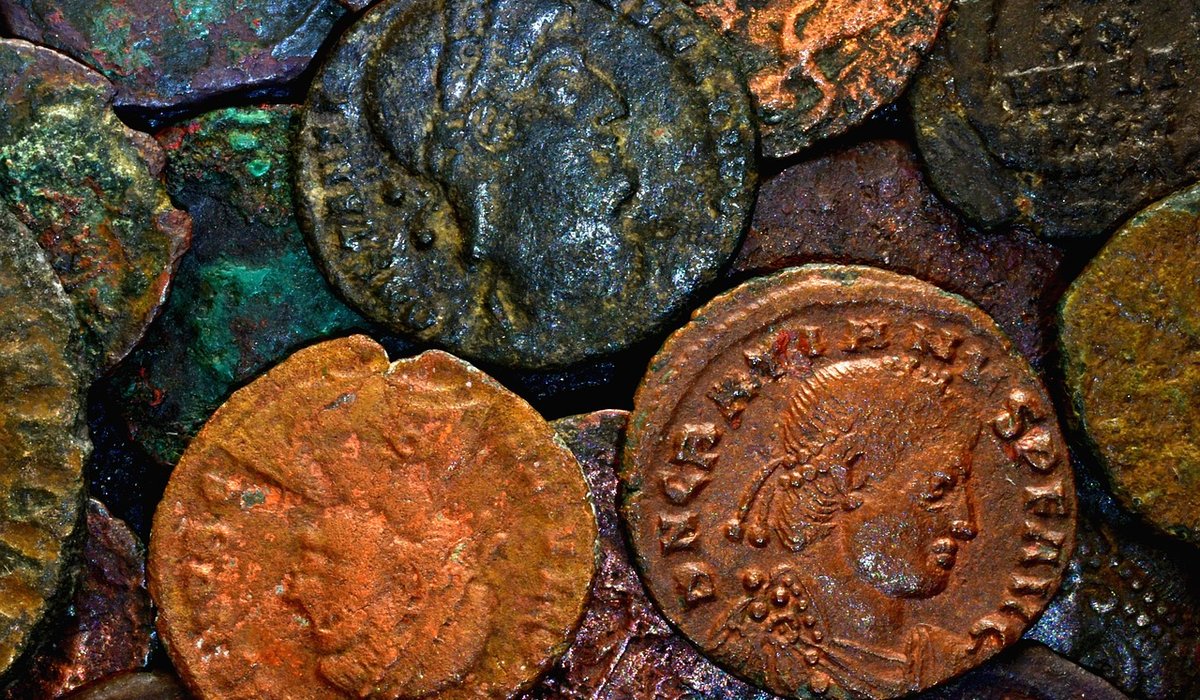
Grading is about wear, not beauty
Grading a circulated coin comes down to one question: how much metal has worn away since it left the mint? That's it. Toning, scratches, edge knocks and surface marks all matter, but they are separate issues. A dark, evenly toned Victorian florin can be a solid Very Fine even if it isn't pretty, while a bright, polished coin can be technically worn and worth far less than it looks. Separate wear from everything else and the whole business becomes much easier.
Find the high points first
Every design has points that stand proudest from the field, and those points take the knocks first. Learn them for the series you collect, because they give you the earliest warning of wear.
- Victorian and Edwardian bronze: the ear and the hair above it, the wreath leaves, Britannia's helmet, shield and trident.
- George V and George VI silver: the lion on the shield, the band of the crown on the monarch's head, the letters of the legend.
- Sovereigns and other St George reverses: the horse's flank and raised foreleg, the lance, the dragon's wing.
- Britannia reverses on 50p and older coins: the helmet crest, the folds of the gown, the shaft of the trident.
Hold the coin at eye level and tilt it under a lamp. On an unworn piece the light catches the high points and the fields reflect smoothly. As wear begins, those high points go matt and lose their crisp edge. That is where your grading starts.
The standard terms in plain English
British grading traditionally runs from Poor up to Uncirculated. The middle of that range is where nearly all circulated coins live.
- Fine (F): roughly half the original detail remains. All the main features are visible, but the high points are clearly flat and the legends may be a little soft. Perfectly collectable and often excellent value.
- Very Fine (VF): light, even wear on the highest points only. Hair, wreath and shield detail stay sharp, and you can count the details rather than guess at them.
- Extremely Fine (EF): only a trace of wear on the very highest point, often visible just with a lens. Any original lustre will be broken only at those highest points.
- Good (G) and Very Good (VG): heavy wear. The outline survives but the detail has largely gone. Useful for filling a gap in a date run.
Beginners often misread "Fine" as a compliment. In coin terms it means a piece that has spent years in circulation — honest, but a long way from new.
Details that tip a coin one way or the other
Once you have the wear pattern fixed in your mind, check the following before you commit to a grade.
- Lettering: are the letters of the legend complete and even in height? A missing top to a letter is usually a sign of wear rather than a weak strike.
- Rims and edge: flattening and dents are damage, not wear, but they still affect value. Always run your eye around the edge as well as the faces.
- Colour and tone: even, natural tone on silver, or a dark, stable patina on bronze, is entirely acceptable. Blotchy or chemical-looking surfaces deserve a second look.
- Surface: hairlines, scratches and tooling marks are defects in their own right. Note them separately from the grade.
Learn to tell wear from a weak strike. A softly struck coin can look worn when it isn't, and knowing a few well-struck examples of the date you are judging is worth more than any book.
Light, magnification and habits worth keeping
Grade in good light — an angled desk lamp rather than flat overhead lighting, or natural daylight near a window. Use a 5x to 10x loupe to confirm a detail, but always grade at arm's length first, because magnification makes the smallest flaw look dramatic.
- Handle by the edges, and keep a soft cloth nearby.
- Never clean a coin. Cleaning strips tone, adds hairlines and destroys value.
- Note the weight and diameter. A coin well under weight may have been clipped, or be more worn than the design alone suggests.
- Grade the same coin twice on different days. Your first reading is often too generous.
Describing a coin to someone else
When you are selling, swapping or asking for advice, be specific. "Victorian penny, 1897, Very Fine: Britannia's trident and helmet crest sharp, light wear on the wreath, a couple of small rim knocks" tells a fellow collector far more than "good condition". Give the date, the type, your grade and any defects, in that order, and make clear that the grade is your own opinion. Most collectors are generous with help when they can see you have looked properly — and the habit of describing coins precisely is what turns a beginner into a confident grader.


Coding is used in almost all aspects of life and work now, be it directly or indirectly. It’s not just for companies in the tech sector. “An increasing number of businesses rely on computer code,
Coding is used in almost all aspects of life and work now, be it directly or indirectly. It’s not just for companies in the tech sector. “An increasing number of businesses rely on computer code,
Coding is used in almost all aspects of life and work now, be it directly or indirectly. It’s not just for companies in the tech sector. “An increasing number of businesses rely on computer code,